

ZYmining
-
Products
-
Application
Grinding circuits can consume more than half of a mineral processing plant's total electrical load, so the choice between high-pressure grinding rolls (HPGR) and conventional ball mills is rarely a purely technical preference — it is a cost decision. Both routes reduce ore to a comparable target size, but they achieve it through fundamentally different breakage mechanisms, and that difference shows up directly in kWh per tonne. This comparison examines where the energy actually goes, what typical specific energy values look like in each route, and under which conditions one technology delivers a genuinely lower power bill for your circuit.
Crushing and grinding are thermodynamically inefficient by nature. Estimates in the technical literature commonly place the energy that actually creates new fracture surface at well under 5% of the total power drawn by a mill. The remainder is lost to elastic deformation, inter-particle friction, heat, noise, and vibration. That single fact explains why the industry keeps searching for a more efficient breakage mechanism rather than simply building larger drives.
Energy consumption in comminution scales with the reduction ratio and the ore's resistance to breakage, usually expressed through the Bond work index (Wi) or a more recent hardness parameter. Two levers therefore exist: reduce the amount of size reduction work required, or change the way the force is applied so that more of it reaches the particle rather than the machine. HPGR and ball mills differ most sharply on the second lever.
A ball mill is a tumbling cylinder filled with steel media. As the shell rotates, the charge is lifted and then cascades or cataracts, delivering a mix of impact and attrition to the ore. Breakage is largely random and single-particle in nature: a grinding ball strikes a particle, or particles are abraded between media. Unavoidable energy sinks include lifting the entire media charge, grinding the liners and media themselves, and producing fines that were already liberated. Slurry transport and classification inside the mill also absorb power.
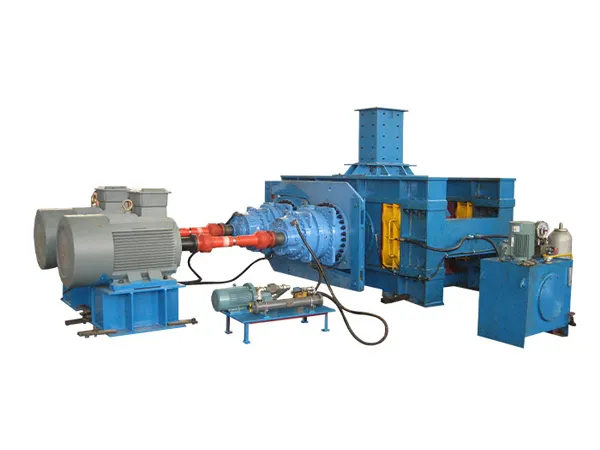
HPGR forces a packed bed of particles between two counter-rotating rolls at very high pressure. Breakage occurs through inter-particle compression: particles press against each other, so the applied force is distributed across many contact points rather than concentrated on a single impact. The result is a product with a high proportion of fines and, critically, a network of micro-cracks along grain boundaries. Those micro-cracks weaken the material for downstream grinding, which is where a large part of the real energy saving originates.
Exact values depend heavily on ore hardness and target size, but published plant data and vendor test work generally fall into recognizable bands:
The caveat is real: an HPGR installed on a soft, highly clay-bearing ore may show a modest advantage, while on a competent, abrasive porphyry copper ore the saving can be substantial. Bench-scale compression tests and pilot runs are the only reliable way to predict the figure for a specific deposit.
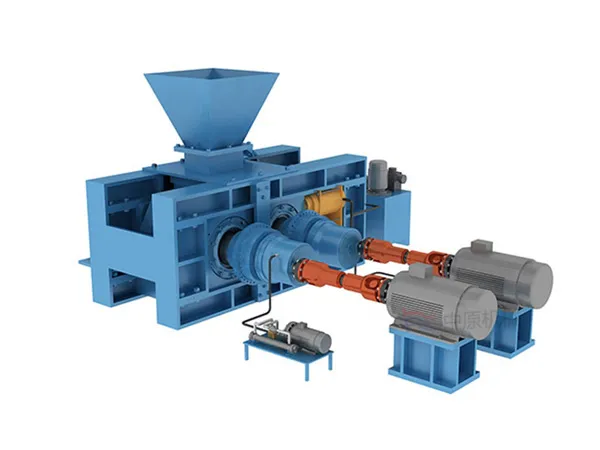
Comparing machines in isolation is misleading, because the energy advantage of HPGR depends on how it is integrated. Three configurations dominate modern flowsheets:
As a supplier of both HPGR units and ball mill systems, ZYmining generally recommends starting with ore characterization rather than a technology preference. Compression tests on drill core, followed by pilot-scale trials, give a defensible specific energy figure that can be plugged directly into a feasibility power model.
Above roughly 14 to 16 kWh per tonne Bond work index, the case for HPGR strengthens quickly, because the energy penalty of impact grinding compounds.
If the liberation size sits above 50 microns, HPGR-led circuits compete strongly. If it sits at 20 microns, expect the ball mill or a stirred mill to remain in the flowsheet.
Feed moisture above roughly 8% to 10%, or significant swelling clay, usually pushes the decision back toward conventional milling unless drying is already planned.
Roll surface life is the dominant maintenance cost of an HPGR. Studded or tungsten-carbide surfaces cost more upfront but change the wear economics substantially on abrasive ores. A total cost of ownership model over ten years is more informative than a simple kWh comparison.
No. HPGR is more efficient at coarse and intermediate sizes. For very fine grinding, or for wet and sticky ores, a ball mill can be the lower-energy and lower-risk option.
In some moderate-fineness applications, yes, particularly with a closed-circuit arrangement. For flotation or leach feeds requiring liberation below 50 microns, most flowsheets retain a tumbling or stirred mill as the final stage.
Plants that add HPGR ahead of an existing ball mill commonly report total grinding energy reductions in the 15% to 30% range, with additional savings from reduced media consumption. The exact figure must be confirmed by ore-specific testing.
On the question of which technology cuts the most energy, the honest answer is that HPGR wins on the coarse half of the size-reduction curve and the ball mill holds its ground on the fine half. The largest savings usually come not from choosing one machine, but from combining them intelligently: HPGR to do the heavy lifting and to pre-weaken the feed, then a correctly sized ball mill to reach liberation. Ore-specific testing, a properly configured circuit, and a realistic wear model will determine whether that combination delivers the kWh reduction your project needs.

Add: Luoxin Industrial Zone,Luoyang City,Henan Province P.R.C.
Tel: +86-379-67313306
E-mail: gloria@zyksjx.com

Official Agent of ZY MINING in Russia.
Please enter here.
Add: Luoxin Industrial Zone,Luoyang City,Henan Province P.R.C.
Tel: +86-379-67313306
E-mail: gloria@zyksjx.com