

ZYmining
-
Products
-
Application
en
Comminution is the largest single consumer of electrical energy in most mineral processing plants, and in hard-rock operations it can account for the majority of the site's power draw. Every kilowatt-hour removed from the grinding circuit therefore flows straight to the bottom line. High-pressure grinding rolls, commonly known as HPGR, have become one of the most credible ways to achieve that reduction, not because they grind more aggressively, but because they break ore in a fundamentally different way. This article explains the mechanism behind HPGR power savings, identifies exactly where the energy gains originate, and sets out the design and operating factors that determine whether those savings are realised in practice rather than simply promised on a datasheet.
Tumbling mills, whether autogenous, semi-autogenous or ball mills, break rock through a combination of impact and abrasion inside a rotating shell. The problem is one of energy transfer efficiency. A significant share of the electrical energy delivered to the mill motor is dissipated as heat, noise, vibration and steel media wear rather than as new fracture surface. Lifting the charge, rotating the shell and the mill's own drivetrain all absorb power before any rock is broken at all.
Two further inefficiencies compound the problem. First, tumbling mills tend to over-grind a portion of the feed while under-grinding the coarsest particles, because residence time is distributed unevenly. Second, liberation is achieved by grinding everything finer than necessary, which consumes energy on material that is already sufficiently liberated. The core inefficiency of conventional grinding is that energy is applied to a random charge rather than directly to the particles that need breaking.

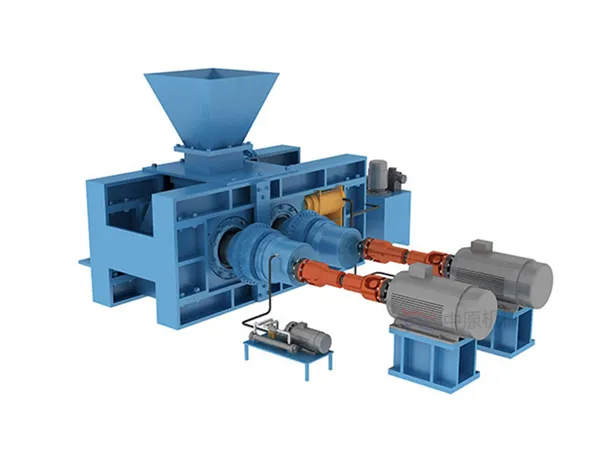
HPGR operates on a principle known as inter-particle, or bed, comminution. Material is fed between two counter-rotating rolls, one of which is fixed while the other is held under hydraulic pressure. The gap is deliberately choked with material, so particles are compressed against one another rather than crushed between two steel surfaces.
As the feed enters the compression zone, roll pressure builds to several tens of megapascals and the particle bed is compacted into a dense cake, often called a flake or scurf. Individual particles are loaded from multiple directions by their neighbours. Because the load is distributed across the whole bed, breakage occurs throughout the material rather than only at the surfaces of the rolls, and the energy is applied to the ore instead of to grinding media.
The most commercially valuable outcome of HPGR is not the immediate size reduction but the damage left behind. Compression along grain boundaries generates a network of micro-cracks through each particle. The discharge cake looks coarse, yet the particles are structurally weakened. When that material reports to a downstream ball mill or stirred mill, it fractures far more easily, which reduces the specific energy required in the following stage. This is the mechanism by which HPGR savings extend well beyond the rolls themselves.
It is worth being precise about the sources of savings, because they are often presented as a single headline figure. In reality the gain is the sum of several distinct effects:
For projects weighing a flowsheet change, the practical comparison is usually between a conventional three-stage crush plus ball mill circuit and an HPGR-based circuit, often in combination with a ball mill or a vertical stirred mill for final grinding.
The comparison is not universally favourable. Ore competence, moisture content, feed size distribution and the required final grind all influence the outcome, which is why pilot-scale testing remains essential before a circuit is committed.
Studded or hard-faced roll surfaces maintain a gripping profile as they wear. When the profile is lost, the rolls slip, throughput falls and the specific pressing force delivered to the bed drops, eroding the energy advantage. Choosing the right surface for the ore's abrasiveness is therefore a direct determinant of long-term power efficiency.
Operating pressure must be matched to the ore. Too little pressure produces an under-compacted cake with weak micro-cracking; too much generates excessive re-agglomeration, higher wear and diminishing returns per unit of energy. Roll speed affects the time available for compression and must be tuned against the required throughput.
Material escaping at the edges of the rolls bypasses the full compression zone and returns as coarse recycle. Effective edge sealing, controlled feed size distribution and stable feed rate are what keep the circulating load low and the net energy saving high.

Because the savings depend on ore-specific behaviour, credible evaluation follows a defined path: representative sampling, bench-scale compression testing, locked-cycle simulation and, where the project justifies it, pilot-scale trials on a continuous machine. ZYmining supports this process with test work and equipment selection based on measured compression behaviour rather than generic assumptions, so that projected power savings are tied to the actual ore body.
Not always. In many flowsheets HPGR acts as a pre-grinding or tertiary crushing stage, and a ball mill or stirred mill performs the final grind. The saving comes from the combined circuit, where the downstream mill starts with pre-weakened feed.
Hard, competent ores show the greatest benefit, but softer ores can also be processed provided the roll surface and pressure are correctly selected. The economics depend on the full circuit rather than on ore hardness alone.
By comparing specific energy consumption, expressed in kilowatt-hours per tonne of finished product, across the complete comminution circuit. Comparing only the rolls against only the mills gives a misleading picture.
In short, HPGR saves power by attacking the inefficiencies that define conventional grinding: it applies force directly to a confined particle bed, avoids energy lost to steel media and charge lifting, and leaves behind a micro-cracked product that is cheaper to grind downstream. Realising those savings depends on correct roll surface selection, properly tuned pressure and speed, controlled feed conditions, and a flowsheet designed around measured ore behaviour rather than assumed performance.
HPGR vs Ball Mill: Which Cuts Energy Most?
No information

Add: Luoxin Industrial Zone,Luoyang City,Henan Province P.R.C.
Tel: +86-379-67313306
E-mail: gloria@zyksjx.com

Official Agent of ZY MINING in Russia.
Please enter here.
Add: Luoxin Industrial Zone,Luoyang City,Henan Province P.R.C.
Tel: +86-379-67313306
E-mail: gloria@zyksjx.com